Kyoto rewards travelers who understand that its finest moments are rarely loud. The city opens slowly: a wooden façade catching first light, the sound of a bicycle wheel in a narrow lane, the scent of roasted tea from a storefront that looks unchanged for decades. Kyoto is not a checklist destination; it is a city of sequences, craft, calm, nature, taste, and meaning, experienced in the right order.
Start in Nishijin, where heritage textile culture still breathes through weaving houses, artisan workshops, and residential streets that preserve old urban proportions and social rhythm. This first layer gives the trip an intellectual base and a graceful pace from the beginning.
Build your second chapter through Nishiki Market’s side corridors, not only the central aisle. The most interesting Kyoto often lives just off the obvious route: knife specialists who sharpen by hand, tea sellers with multi-generation knowledge, pickle artisans preserving seasonal methods, confectioners shaping wagashi as edible design, and paper/stationery stores where wrapping itself is treated as craft. Add one stop for incense and one for ceramic tableware, and your shopping becomes collection, not consumption. This is where affluent travelers find value: provenance, precision, and objects with story.
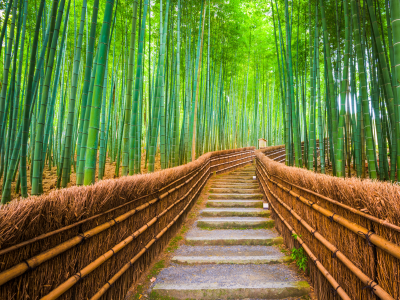
Now keep the nature rhythm without losing refinement: include Arashiyama’s quieter edges at off-peak windows. Rather than entering at peak crowd flow, approach through calmer connectors, riverside paths, and local streets where bamboo appears as part of living landscape, not only a photo point. Pair the route with one discreet tea house, one seasonal sweets stop, one scenic river pause, and one short transfer segment to preserve comfort and energy. In this format, Arashiyama feels elegant and breathable, natural beauty with composed movement.
For a more immersive mobility layer, add the Cycling Course in Saga-Arashiyama as a discovery tool. The bicycle here is not about effort; it is about access. It opens narrow stretches, micro-viewpoints, and transitional spaces between river, grove, and neighborhood life that cars and buses miss. Structure the cycling route with four intentional pauses: one design corner, one tea break, one river reflection point, and one craft stop. This turns motion into storytelling and gives the day a signature memory arc.
Keep Kyoto’s cultural depth explicit through a full intellectual and sensory heritage chapter: tea culture, incense etiquette, paper craft, lacquer detail, kimono-textile language, and calligraphy materials that reflect Japanese ideas of discipline and beauty. Add one guided tea tasting, one incense-focused boutique, one washi/paper atelier, and one textile gallery. This chapter is especially valuable for the affluent audience because it delivers both elegance and knowledge, experience with context, not just aesthetics.
Then include a full hidden nature day in a quieter Kyoto pocket such as Ohara or comparable outskirts where village scale, seasonal textures, mountain air, and low-density movement reset the mind. Plan this day with soft transitions: late morning walk, tea pause, local lunch, slow scenic segment, and an early-evening return. The hidden gem here is not one landmark, it is the entire atmosphere of spaciousness, silence, and rural Kyoto continuity.
For Muslim-friendly comfort, Kyoto works best with pre-curation: reserve your key meal windows, confirm ingredients and preparation style in advance, and keep one seafood-forward backup option each day. This allows you to move confidently between cultural chapters without operational friction. Add rest buffers between dense modules (market → craft → nature → dinner), and the city feels premium, not exhausting.
Close with an evening sequence built for memory rather than noise: Gion side lanes away from dense strips, a refined dinner in a discreet setting, one final matcha or dessert moment, then a soft-lit walk through quieter connectors where Kyoto feels intimate and timeless. The hidden luxury here is layered serenity, where water, bamboo, paper, tea, fabric, and light form one coherent travel narrative. Kyoto does not ask you to rush; it invites you to notice.
Attractions & Experiences:
Nishijin textile district heritage exploration
Multi-stop craft route: weaving, paper, incense, ceramics
Nishiki Market side-corridor culinary discovery
Artisan knife and tea specialist visits
Wagashi and seasonal sweets atelier stops
Arashiyama quieter-edge route
Bamboo landscape segments around Arashiyama
Riverside scenic pauses and low-noise connectors
Cycling Course in Saga-Arashiyama with curated stops
Intellectual heritage route: tea, incense, washi, lacquer, textiles
Kimono-textile gallery and calligraphy material boutiques
Hidden nature day in Ohara / Kyoto outskirts
Curated halal/seafood dining sequence
Gion calm-lane evening walk
Matcha/dessert finale in a refined low-noise setting