Some destinations are best understood together. Petra and Amman offer Jordan in two complementary forms: one carved into silence and sandstone, the other lived through hills, mosques, markets, and everyday warmth. This is not only a route between two places, but a fuller encounter with Jordan itself, its landscapes, its heritage, its Islamic rhythm, and its ability to hold grandeur and intimacy in the same journey. Petra remains one of Jordan’s defining heritage experiences, while Amman gives the country its daily pulse, cultural texture, and human scale.
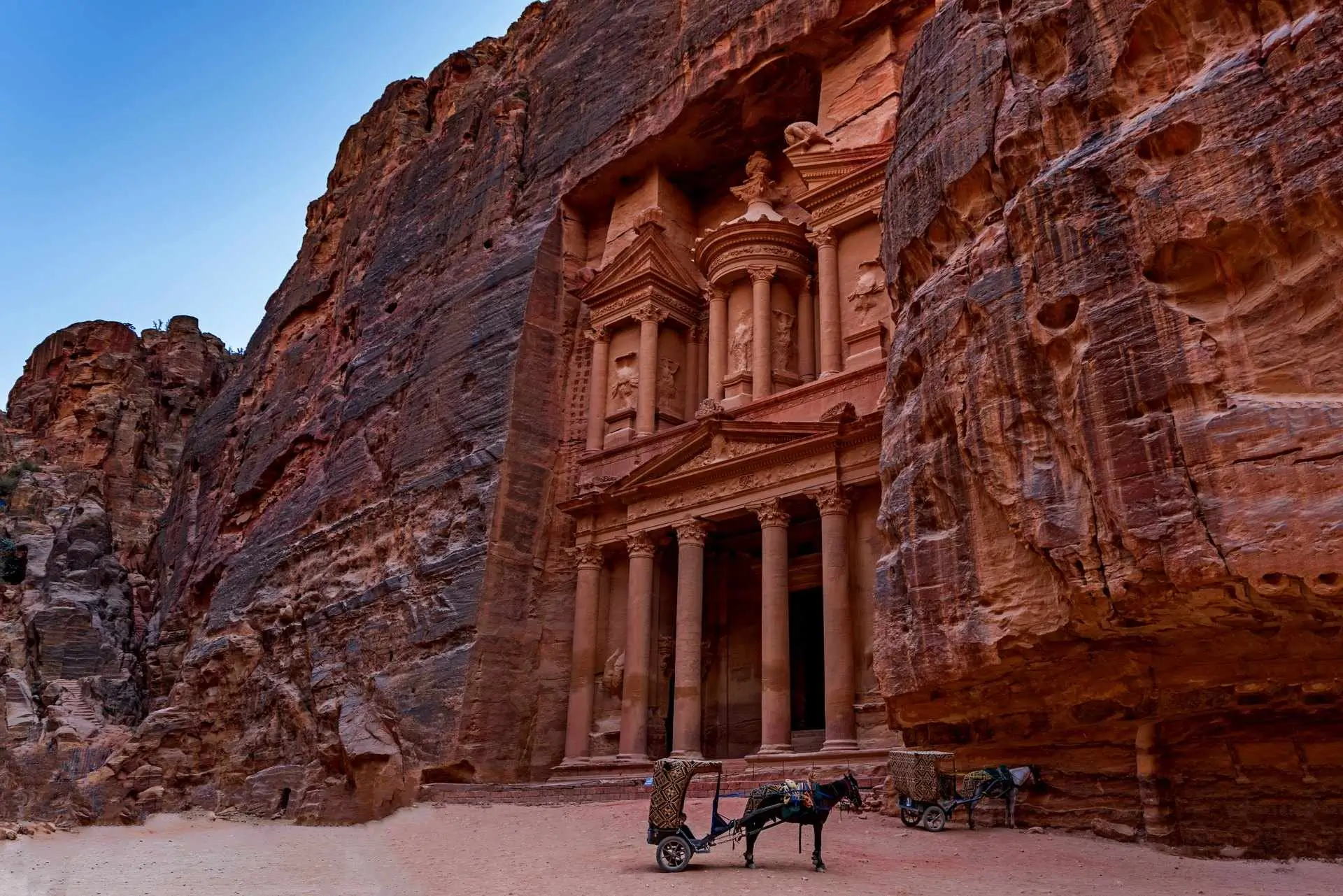
Begin in Petra before the day fully unfolds. Enter through the Siq while the stone is still cool and the passage remains quiet enough for the landscape to speak first. The approach matters here. Petra is not meant to be consumed at speed; it is meant to build slowly, with the narrow gorge sharpening anticipation until Al-Khazna appears almost as revelation rather than monument. That measured arrival is part of Petra’s power, and it is one of the reasons the site stays with travelers long after they leave.
Stay longer than the first view demands. Walk beyond the Treasury into the wider archaeological landscape, where Petra begins to feel less like a single landmark and more like an entire world of carved facades, open valleys, ancient pathways, and shifting color. The quieter reward comes when you give space to its lesser-seen layers: the northern approach through Mughur al-Nasara, the rise toward the Monastery, and the route out to Little Petra, once an important early Nabataean settlement and caravan stop. Petra becomes most memorable when it expands from spectacle into terrain, distance, and memory.
If time allows, let the Petra region soften around you rather than leaving as soon as the main site is done. Wadi Musa gives the experience breathing room, and the museum gives it language. The value of Petra is not only in what the eye sees, but in what the place gradually explains: trade, movement, adaptation, and a civilization that understood both engineering and grandeur. This is why the journey works so well, not because it is famous, but because it rewards those who slow down enough to absorb it.
Then let Amman receive you in a completely different register. After Petra’s carved silence, the capital feels alive through slope, sound, and lived continuity. Begin with the Citadel for perspective and for the Umayyad Palace complex, which places early Islamic presence clearly within the city’s historic core. But Amman becomes truly rewarding only once you move beyond the obvious.
Jabal Al Lweibdeh is one of the best places to feel this. Its older houses, slower rhythm, and creative spaces give Amman a more intellectual and intimate character. Nearby, Darat al Funun offers one of the city’s most beautiful cultural pauses: gardens, old stone homes, art, archaeology, and views that open over old Amman with unusual grace. Continue through stairways and side streets toward Jadal, then down into Al-Balad, where the city reveals its daily pulse through souqs, old storefronts, simple food, and the kind of urban life that still feels unmanufactured. This is the Amman that stays with people.
From there, let the city open into its more soulful hidden gems. Stand near the Grand Husseini Mosque and watch how downtown gathers around it. Pass through Souq Al-Sukar, step into Duke’s Diwan for a glimpse of an earlier Amman, and continue later toward Rainbow Street without allowing it to define the city on its own.
Petra gives Jordan its majesty; Amman gives it intimacy. Together, they form a journey of stone, faith, memory, and human presence, exactly the kind of pairing that rewards a thoughtful traveler.
Attractions & Experiences:
The Siq
Al-Khazna (The Treasury)
Petra Archaeological Park trails
Little Petra (Siq al-Barid)
Petra Museum
Wadi Musa as Petra’s gateway town
Amman Citadel
Umayyad Palace
Downtown Amman (Al-Balad)
Rainbow Street
Jabal Al Lweibdeh
Jordanian Museum of Traditional Costumes and Jewelry