

It is part of God’s wisdom in His legislation that the acts of worship He prescribed for His servants bring immense benefits: they refine their behavior, cultivate their character, and bring peace to their hearts. For this reason, those who perform their duties with sincerity often carry serenity in their faces, and it becomes evident in their actions.
Hajj, of course, is no exception; in fact, it enhances this principle. The pilgrim returns as a different person, as though Hajj has restructured his priorities and cleansed his soul, purifying it. Those closest to him notice this transformation. But why does this happen? What is it about Hajj that has such a profound effect on a Muslim’s soul? What happens during this journey that leaves such a deep impact on the human spirit?
How Does the Hajj Journey Affect the Soul and Behavior?
The journey of Hajj is one of detachment from worldly pleasures; a path of spiritual discipline and purification for the soul and desires. The pilgrim embarks on this journey to seek closeness to God, aiming to gain His approval in the holiest place on Earth. When someone leaves behind the comforts of the world with the intention of purity and closeness to God, their soul undergoes a permanent transformation. After detaching from the distractions of the world for a few days, their perception of life is never the same again.
Moreover, anyone who contemplates the deeper meanings of the pillars of Hajj will uncover an immense psychological depth to this sacred act. The pilgrim abandons his titles, wealth, and worldly pleasures, shedding all ties to his life as though this scene mirrors the moment when the servant stands before their Lord on the Day of Judgment—standing alone, humbled, carrying only their piety and deeds. This principle also manifests in the sight of the rich and the poor, the king and the commoner, the scholar and the illiterate, standing side by side. This scene, which speaks of the equality of creation before their Creator, was once unimaginable before the dawn of Islam. No poet’s words could capture it, yet today it is embodied in Hajj, a sight we witness annually.
Thus, anyone who embarks on this transformative journey gains a new perspective on the distractions of life, recognizing that all of it is but a fleeting stop, and that true life lies in the Hereafter.
The Hajj Journey Through the Pilgrim’s Eyes, Step by Step
The Beginning of the Journey: From the Intention of the Heart to the Gateway of Peace
The journey begins with the pilgrim’s decision to leave behind their family, wealth, and worldly life to embark on a journey toward Allah. This act may seem small, but letting go of everything familiar to set out on a path of humility to the Almighty is no small feat. It is from this very moment that the journey of transformation begins! The pilgrim even sheds the clothes they have long been accustomed to, donning the simple cotton attire of Ihram, which will accompany them through the stages of a journey from which they will never return unchanged.
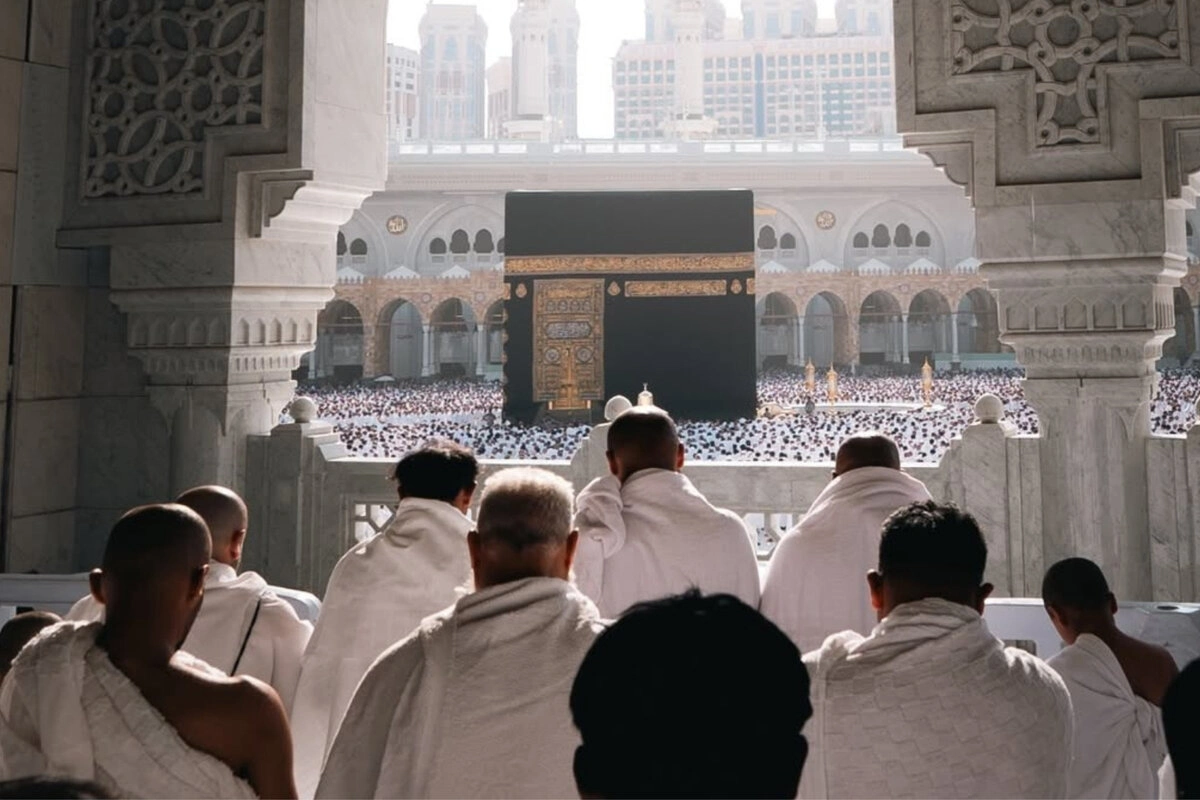
What Does the Pilgrim Feel When They Arrive in Mecca and See the Kaaba?
If you were to ask a pilgrim about their feelings when they first saw the Kaaba, you would find them at a loss for words, as no description can do justice to that moment. Perhaps the best way to describe it is a mix of familiarity with a place one has always known, and awe and reverence. Imagine standing before Allah in His most beloved place on Earth! As images flood your mind—memories of the Prophet and his companions spreading the message of Islam, the conquest of Mecca, and the purification of the Kaaba from idols—you now stand with millions of pilgrims, side by side, answering a call that has echoed for thousands of years, the call of our father Ibrahim, peace be upon him, which Allah made a reality, and for which the Prophet Muhammad (peace be upon him) endured great hardship. How do you describe such feelings? How can these images be captured in just a few words?
Tawaf Around the Kaaba: An Experience That Purifies the Heart
If you were to observe the tawaf (circumambulation) around the Kaaba from above, you would witness a remarkable sight, as though the pilgrims are in the deepest connection with the universe. Their motion mirrors the rotation of electrons around an atom’s nucleus, the orbit of planets around a star, and the revolution of galaxies around a center. The Creator is One, the system is One, and all of creation is inherently inclined to follow Him.
Looking closely at each pilgrim, you would see emotions distilled into the essence of monotheism, reverence, and sanctification. Their tongues are busy with prayer, and at that moment, the servant is as close as they can be to their Lord. This closeness purifies the heart and fills it with the certainty that true life is the life of the Hereafter, not the life of this world.
The Say’i Between Safa and Marwah: Between Hope and Certainty
Hajj is never without difficulties; on the contrary, it seems that the challenges of this sacred pilgrimage teach us that spiritual rewards come through physical effort. The act of walking seven laps between two mountains is no simple task, yet it takes us back in time to the story of Lady Hagar and her infant son Isma’il, peace be upon them, in a barren valley where no hearts could find shelter. But her faith in God was greater than the limits of this world and its physical reality. When she feared for her child, exposed to the heat and thirst, she ran back and forth in search of water to quench his thirst and strengthen his body. Though she found none, she never grew weary or tired; she made seven rounds between the two mountains! What determination you had, O Hagar! What trust in God this was!
Then, the Most Merciful, the Most Compassionate, does not refuse a servant who raises their hands and asks of Him. How, then, could He reject a lonely woman in the desert searching for food for her child? So, He caused a spring from the gardens of Paradise to gush forth for her, known as the Zamzam well, a source of water that we continue to drink from to this day.
The Day of Arafah: The Pinnacle of Spiritual Purity
The Day of Arafah is the greatest of days in the sight of Allah. On this day, Allah perfected the religion of Islam and chose it for us. It is the day when we bear witness that the Prophet Muhammad (peace be upon him) fulfilled his mission.
On this day, the pilgrims leave the Grand Mosque and head toward the plains of Arafah, where they stand before Allah for an entire day, glorifying Him, praising Him, and praying for what their hearts desire. Meanwhile, millions of Muslims who have not been able to perform Hajj that year fast in solidarity, creating a powerful image of unity, as they are one Ummah, regardless of the geographic divisions between them.
Mina and Muzdalifah: Tranquility Amid Simplicity
After fulfilling the duty of the Day of Arafah, the pilgrims head toward Muzdalifah to spend their final night in this sacred place. Though parting may feel sorrowful, it is a night of celebration! The pilgrim gathers their pebbles and prepares to head toward Mina to throw the stones at the Devil. Upon waking, they bid farewell to Muzdalifah and continue their journey to Mina, where they will spend the days of Eid, perform the stoning ritual, and then complete their purification. Afterward, they return to Mecca to perform the Tawaf al-Ifadah and bid farewell to this transformative journey, carrying with them the values that have been planted in their hearts.
What Values Does the Pilgrim Gain During His Journey?
Throughout the Hajj, the pilgrim trains his desires, refines his soul, and endures the hardships of the journey. You will see him embody piety, humility, and detachment from worldly life, with the values of equality and justice instilled in his heart. In short, Hajj is a rich experience full of spiritual and human values that leave a profound impact on the pilgrim’s life. These values help him strengthen his relationship with Allah and improve his behavior toward others in his everyday life.
How Does the Pilgrim Maintain the Change After Hajj?
The end of the Hajj journey does not mean the closing of the door to that spirituality—on the contrary, it is just the beginning! The pilgrim’s preservation of his acts of worship, his continued closeness to Allah through voluntary prayers, his detachment from the temptations of this world, and his commitment to avoiding sinful actions, as well as his persistence in patience, justice, and equality—everything he has learned throughout this short journey—will make him see himself as a transformed person. He will have learned and strived in his path toward Allah.
Does the Effect of Hajj Last in the Long Term?
When the pilgrim reaches Mecca, he realizes that his heart has never been in a place as sacred as this one. The Kaaba stands before him, and his heart beats with emotions beyond description, a mix of joy, tears, and awe. In this moment, Hajj reshapes his soul, making him face himself with deep honesty. He feels as if all his sins have been washed away, and all his pains have disappeared in those sacred moments. When he returns, he is the same person, yet his spiritual compass has shifted direction. It is a profound inner transformation, one that cannot be measured by days but by actions and intentions. He becomes more humble, more patient, and closer to Allah. Hajj, for him, is not just a set of rituals to be performed; it is a journey in which his soul has learned how to live in inner peace and embody compassion toward others. After his return, this transformation remains alive in his heart, influencing his decisions and granting him the strength to face life’s challenges with greater determination and deeper faith.