

Al-Andalus was not simply a land that was conquered and later lost. It was a civilization that illuminated centuries of history, bringing together knowledge, art, and cultural diversity. Its legacy remains visible today in Spain’s cities, language, and culture. From the mountains of Gibraltar to the palaces of the Alhambra, the story of Al-Andalus spans centuries of victories, conflicts, and transformation. It tells the story of an extraordinary civilization that began with conquest, reached the height of prosperity, and eventually lost its political rule, while its influence endured.
In this article, we explore the defining chapters of this civilization, whose legacy continues to inspire travelers and draw visitors to its historic remains.
What Is the Story of the Conquest of Al-Andalus?
At the height of the Umayyad Caliphate’s victories, as Muslim conquests expanded east and west, the Maghreb came under Islamic rule. It gradually achieved stability under the distinguished commander Musa ibn Nusayr. Muslim attention then turned towards the fertile lands of Al-Andalus, with the hope of spreading Islam there.
The ambition to reach Al-Andalus, however, was not new to that particular period of Islamic history. Muslim hopes had been connected to the region since the caliphate of Uthman ibn Affan, may Allah be pleased with him. The significance of conquering Al-Andalus became especially apparent when Muslim forces attempted to conquer Constantinople. Although they successfully placed the city under siege, they were unable to capture it. The Rightly Guided Caliph Uthman ibn Affan is reported to have said: “Constantinople can only be conquered from the sea. If you conquer Al-Andalus, you will share in the reward of those who conquer Constantinople.”
Several obstacles stood in the way of the Muslims and Al-Andalus. These included the region’s rugged, unfamiliar landscape, the limited number of warships available to the Muslim forces, and the relatively small size of the Muslim armies compared with the Christian forces, which were protected by military equipment and fortified castles.
At the time, the lands of Al-Andalus were home to rival tribes and kingdoms. One of these was the Visigothic Kingdom, ruled by a powerful leader, Roderic, known for oppression and tyranny.
During his rise to power, Roderic had made many enemies. Among them was Julian, the governor of Ceuta, who sent messengers to the governor of Tangier, the renowned commander Tariq ibn Ziyad, seeking to negotiate an alliance with the Muslims and put an end to Roderic’s oppression.
The alliance was reportedly based on several conditions. Julian agreed to surrender the port of Ceuta to the Muslims and provide them with detailed information about the geography and people of Al-Andalus. In return, the lands and estates Roderic had seized from their owners, estimated at 3,000 villages, would be restored. With this agreement, the dream of conquest seemed closer than ever, and the fertile lands of Al-Andalus appeared almost within reach.
The campaign began cautiously. Musa ibn Nusayr ordered the deployment of an exploratory force led by Tarif ibn Malik. After a full year of successful reconnaissance missions, the plan for the conquest was finalized. An army of seven thousand Muslim soldiers was assembled under the leadership of Tariq ibn Ziyad. An additional five thousand soldiers later reinforced it.
When the Muslim armies entered a territory and encountered opposing forces, they offered them a choice: accept Islam and retain their property, pay the jizya and retain their property, or face war.
A series of battles followed between the Muslim and Christian forces. Within a few years, the Muslims had brought most of the Iberian Peninsula under their control, although military campaigns and resistance continued in parts of the north.
What Made Islamic Civilization in Al-Andalus Exceptional?
From the moment an Islamic civilization emerged in Al-Andalus, it became a beacon connecting East and West. It radiated excellence in administration, science, and engineering. Most importantly, it carried a spirit of coexistence and peace between communities that might never have encountered one another anywhere other than the remarkable land of Al-Andalus.
Andalusian society included Arabs, Amazigh people, and the local inhabitants of the Iberian Peninsula. The three Abrahamic religions came together to create a cultural harmony that stirred the heart and gave the tongue a melody to repeat. It was a harmony whose echoes the world continues to miss, while many still dream of its former glory. One of the wonders of Al-Andalus was that, despite being composed of communities with diverse origins, cultures, and ancestries, its society was built on close interaction and constant exchange rather than complete separation.
The cities of Al-Andalus brought together diverse communities in everyday life. People interacted through trade, medicine, and many other areas of shared existence. This contact profoundly shaped Andalusian culture. Every community left its mark on this flourishing civilization. At the same time, their interaction encouraged the exchange of knowledge, languages, and customs. Arabic became a defining feature of Andalusian civilization. It was the language of science and knowledge, the language of reflection and intellectual thought, and a language that foreigners took pride in learning and mastering.
This cultural interaction also accelerated the exchange of knowledge. Al-Andalus helped circulate works written in Arabic, while cities such as Toledo later became centers of a vast translation movement. Scientific and philosophical works were translated from Arabic into Latin and Castilian, making this knowledge more accessible throughout Europe.
Al-Andalus was also fertile ground for the arts and cultural exchange. Christian art blended with Arab and Islamic artistic traditions, a combination still visible in countless details, particularly in architecture. The region later gave birth to distinctive artistic forms of its own, including the Andalusian muwashshahat, poetic compositions whose melodies stir the heart and awaken longing for the glory of a civilization unlike any other in history.
Are Muslim Monuments Still Standing in Spain Today?
Yes, Islamic monuments still stand in Spain today. The civilization of Al-Andalus lasted for nearly eight centuries, leaving a deeply rooted mark that changed the course of history in the Iberian Peninsula, and perhaps beyond. It is therefore unsurprising that the Islamic monuments of this period are among Spain’s most captivating attractions, admired by visitors from around the world for their individuality and extraordinary beauty.
Córdoba, the magnificent capital of Al-Andalus, remains filled with towering witnesses to the achievements of Muslim civilization. Among them is the Great Mosque of Córdoba, with its columns, arches, and vast prayer hall. There is also Madinat al-Zahra, with its grandeur, beauty, and palace, once considered one of the wonders of its age. The city’s Arab baths, waterwheel, and many other surviving structures further reflect the legacy left by the Muslims.
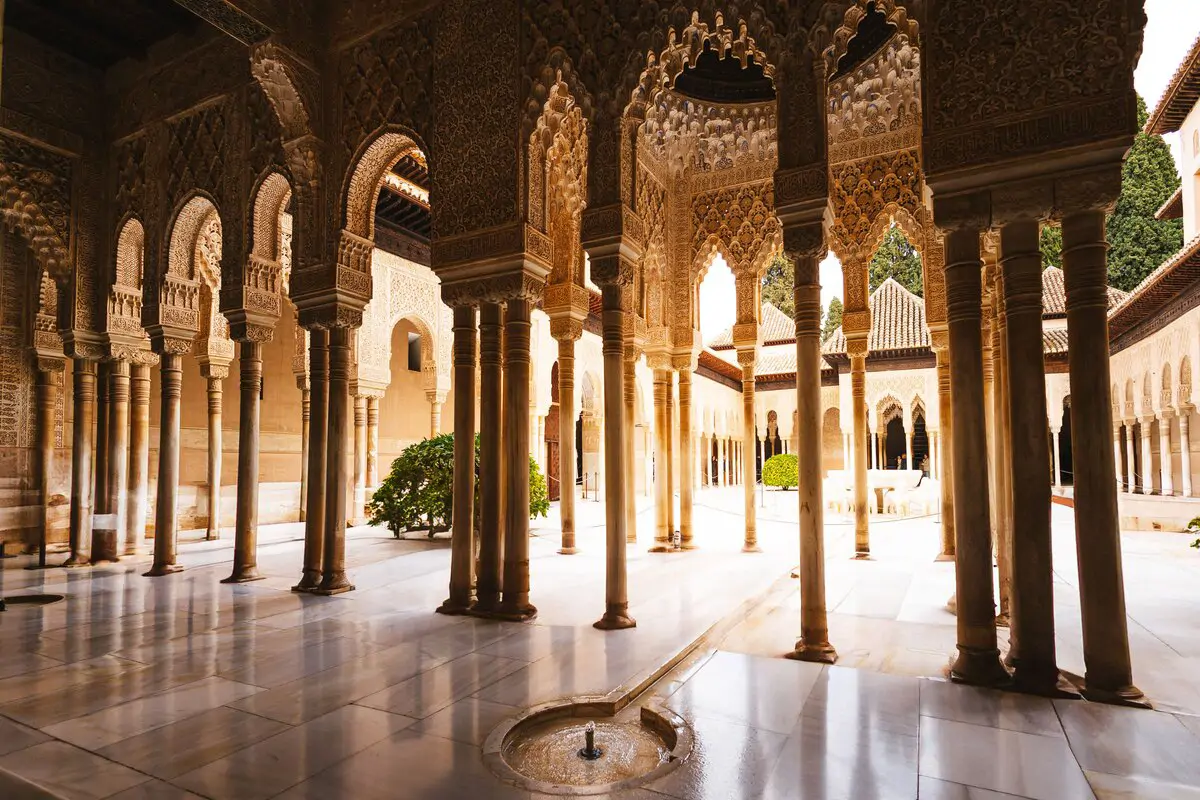
Granada and the Alhambra Palace must not be forgotten. Few palaces or buildings can be compared with it. Thousands of tourists pass through its halls, and entering the palace feels like traveling through time into a world containing some of the finest achievements of Islamic Andalusian culture. Any discussion of the Alhambra must also mention the Fountain of the Lions, which remains an extraordinary example of engineering and one of the mysteries of this remarkable civilization.
The fountain consists of a marble basin supported by twelve marble lions. Several stories have been told about the precision of its water system. One account claims that it was designed as a water clock, with water flowing from the mouth of a different lion every hour until a complete cycle was finished after twelve hours. It is also said that Spanish engineers once attempted to dismantle the fountain to uncover its secrets, damaging it and causing its original mechanism to be lost forever. However, popular stories about the fountain functioning as a water clock lack conclusive historical evidence. Although attempts to understand the secrets of its water system have continued, little definite progress has been made.
The Albaicín neighborhood also offers visitors a journey into the atmosphere of Arab life in Al-Andalus. Its whitewashed houses and narrow streets seem crowded with the voices of former residents and passers-by, echoes suspended in history and still celebrating the greatness of this civilization’s contribution to humanity.
How Did Al-Andalus Influence Modern Spanish Culture?
The influence of Andalusian culture extended beyond the buildings left behind after the end of Islamic rule. It also extended into the Spanish language, the arts, and even the customs and traditions of the Spanish people, many of which carry elements of Arab and Islamic culture.
For this reason, it is often said that the Spanish are among the European peoples closest in spirit to the Arabs.
One of the clearest signs of this influence is the linguistic connection between Arabic and Spanish. Spanish contains a large number of Arabic words, particularly in agriculture, food, administration, and daily life. Examples include words relating to olives, sugar, mayors, and algebra.
Architecture and garden design were also strongly influenced by Islamic traditions. This influence is particularly visible in southern Spain, where horseshoe arches, fountains, floral decoration, and patterned ceramic tiles remain widespread. These architectural and decorative techniques continued to be used even after the fall of Al-Andalus, eventually contributing to the development of what became known as Mudéjar art.
Spanish society also preserved many aspects of Andalusian culture after the end of Islamic rule. Even when Al-Andalus ceased to exist as an Islamic caliphate, eight centuries of history could not simply be erased overnight. On the contrary, elements of this culture remained and continued to develop. A Spanish speaker may use words of Arabic origin, eat foods associated with the Andalusian period, live in or visit buildings with courtyards, fountains, and Islamic decoration, and listen to music that developed within the culturally diverse environment of Al-Andalus.
Al-Andalus should therefore not be seen as a separate chapter from Spanish history. It is a fundamental layer of Spain’s modern identity, one that blended with other historical influences to create a remarkably diverse culture.
What Is the Story of the Fall of Al-Andalus?
The laws of God that govern this world favor no one. In His wisdom, they were established so that all people and civilizations would remain subject to them. One of these universal truths is expressed in the saying: “What goes up must come down.”
Kingdoms and civilizations resemble human beings. They are born in weakness, grow stronger, reach maturity, yet their strength eventually fades and returns to weakness. As stated in the Quran: “Allah is the One Who created you in a state of weakness, then developed weakness into strength, then developed strength into weakness and old age. He creates whatever He wills. And He is the All-Knowing, Most Capable.”
This is what eventually happened to Andalusian civilization. After approximately eight centuries, Islamic political rule ended in 1492, bringing this flourishing era to a close.
Its fall, however, cannot be attributed to a single cause. History cannot be understood by isolating one battle and declaring it the decisive turning point. The fall of Al-Andalus was a long process of political fragmentation, wars, alliances, and changing balances of power. It was a path marked by ambition, rivalry, and political upheaval. It stretched across nearly five centuries, beginning with the collapse of the Caliphate of Córdoba and ending with the surrender of Granada in 1492.
The first crack in this once formidable stronghold appeared with the collapse of the caliphate in Córdoba. This collapse was itself the outcome of years of political struggles, revolts, and conflicts known as the Fitna of Al-Andalus. Princes, military commanders, and armies competed for power, while several caliphs succeeded one another within short periods. This instability eventually led to the formal abolition of the caliphate. The centralized state fragmented into a collection of smaller kingdoms known as the taifa kingdoms.
Although the taifa period witnessed remarkable prosperity in poetry, the arts, and the sciences, it was also an era of severe political weakness. The taifa rulers no longer viewed Al-Andalus as a single, united entity. Each ruler defended their own kingdom and pursued their own interests independently of the others. The taifa rulers competed for land and influence, entering wars and forming alliances that were constantly changing. Many of these conflicts ended with Muslims killing fellow Muslims and committing terrible acts against the defeated. Yet, when these conflicts are examined carefully, it becomes clear that everyone ultimately lost, even when individual rulers believed they had won.
Some taifa kings even sought assistance from Christian kingdoms against their Muslim rivals. In return, they paid money or surrendered fortresses to those kingdoms.
The Christian powers took advantage of these divisions within the Muslim ranks, seeing them as opportunities presented on a golden platter. This period was later documented in their history as the Reconquista, referring to the Christian reconquest of lands that had come under Muslim rule.
By acting in this way, the taifa rulers placed themselves at the mercy of the Christian kingdoms. They paid financial tributes to rulers in Castile, León, and Aragon in exchange for protection or temporary peace. These payments became an important source of funding for Christian armies, while the taifa kingdoms’ resources were steadily drained.
The capture of Toledo by Alfonso VI, King of Castile and León, in 1085 marked a major turning point. Toledo held a strategic position in the center of the Iberian Peninsula and had long enjoyed significant political and cultural importance. Its fall demonstrated that the taifa kingdoms were no longer capable of stopping Christian military expansion on their own.
For this reason, the taifa rulers appealed to the Almoravids of North Africa for assistance. The Almoravids succeeded in halting Alfonso’s advance and later united large parts of Al-Andalus under their authority. Although the Almoravids successfully reunited much of Al-Andalus and temporarily halted Christian expansion, their state eventually weakened because of internal conflict, military pressure, and the rise of a new power in the Maghreb, the Almohad state.
The Almohads later took control of Al-Andalus during the twelfth century and achieved several victories. However, they suffered a decisive defeat at the Battle of Las Navas de Tolosa, also known as the Battle of al-Uqab, against an alliance of Christian kingdoms. Following this defeat, Al-Andalus once again fragmented into smaller states.
After the Battle of al-Uqab, the armies of Castile, Aragon, and Portugal advanced more rapidly.
Al-Andalus lost most of its major cities, including Córdoba, Valencia, and Seville. Gradually, Christian forces moved deeper into Andalusian territory until only the Nasrid Kingdom of Granada remained in the far south. Granada defended itself fiercely and survived for more than two centuries. Nevertheless, internal disputes within the Nasrid ruling family, combined with the alliance between Castile and Aragon following the marriage of Isabella I of Castile and Ferdinand II of Aragon, proved decisive in delivering the final blow. The last war lasted for a decade. It was a devastating and painful conflict, heavy on the hearts of Muslims both at the time and to this day.
The war ended when Abu Abdallah al-Saghir, the ruler of Granada, entered secret negotiations with the Catholic Monarchs. The two sides agreed that Granada would be surrendered and Islamic rule in Al-Andalus would come to an end. In return, the Catholic Monarchs promised that Muslims would be allowed to practice their religion and preserve their mosques and cultural heritage. Granada was formally surrendered in January 1492, bringing to an end a period of Muslim rule that had begun in 712.
What happened afterward belongs to another chapter in the history of the Iberian Peninsula.
At first, Muslim rights were protected under the terms of the surrender agreement. This situation, however, did not last. Muslims later suffered severe persecution and torture, forcing many to flee with their families and their faith into the mountains.
In closing, it is important to clarify that the Muslim presence in the Iberian Peninsula did not end with the fall of Al-Andalus. What ended was Muslim political rule. The Spanish Inquisition did not persecute only Arab Muslims. It also targeted Spanish Muslims and local inhabitants who had embraced Islam. In other words, people were persecuted within their own homeland simply because they followed a different religion.
The heart aches when exploring the history of the Moriscos and the restrictions, persecution, and suffering they endured, experiences so severe that words can barely contain them.
Many customs still present in Spanish society today are remnants of this historical period, when Muslims fled to protect their faith and chose isolation rather than abandoning their beliefs.
Their political rule may have ended, but their influence continues to echo through Spain to this day.